
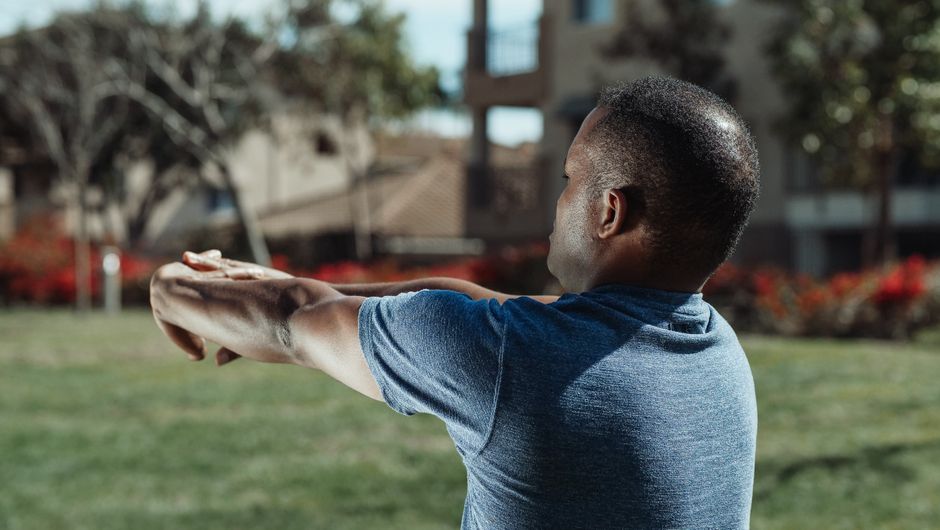
Sitting at a desk tends to pull the shoulders forward and up, and after a few hours that position starts to feel normal. Stretching will not undo a whole workday, but a couple of short breaks can take the edge off the stiffness. Below are ten stretches that need no equipment and fit between meetings.
How We Picked
- Doable at a desk. Most can be done seated or standing in a small space, in work clothes.
- Targets the right areas. Each one reaches the upper back, chest, neck, or shoulder joint itself — the places desk posture tends to tighten.
- Low risk. Gentle, controlled ranges of motion rather than aggressive pulling or weighted stretching.
- Short. Nothing here needs more than about a minute.
- Commonly recommended. These are standard stretches found in physiotherapy and workplace ergonomics guidance, not novelty moves.
One note on evidence: research on stretching for desk-related neck and shoulder discomfort is mixed, and the effects reported are usually modest and short-lived. Moving regularly throughout the day appears to matter at least as much as any particular stretch.
1. Shoulder Rolls
Sit or stand tall and let your arms hang. Roll both shoulders up, back, and down in a slow circle, then reverse. Keep the movement unhurried rather than shrugging quickly. Ten circles each way is plenty.
Best for: loosening up before the other stretches.
2. Upper Trapezius Side Bend
Sit upright and let your right hand rest on the side of your chair. Tilt your head gently to the left, as if bringing your ear toward your shoulder. You can place your left hand lightly on your head, but let gravity do most of the work. Hold around 20-30 seconds per side.
Best for: the ropey tightness along the top of the shoulders.
3. Levator Scapulae Stretch
Turn your head about 45 degrees to the left, then look down toward your armpit. You should feel a stretch along the back-right side of your neck. Keep both shoulders level and resist the urge to hunch. Hold 20-30 seconds, then switch.
Best for: the spot between the neck and the shoulder blade.
4. Cross-Body Shoulder Stretch
Bring your right arm straight across your chest and hook your left forearm under it, drawing it in toward you. Keep the right shoulder down rather than letting it ride up toward your ear. Hold 20-30 seconds each side.
Best for: the back of the shoulder, which gets little movement while typing.
5. Overhead Triceps Stretch
Reach your right arm overhead, bend the elbow so your hand drops behind your head, and use your left hand to ease the elbow back a little. Stand or sit tall and avoid arching your lower back. Hold 20-30 seconds per arm.
Best for: overhead reach and the back of the upper arm.
6. Doorway Chest Opener
Stand in a doorway with your forearms on the frame, elbows at roughly shoulder height. Step one foot forward until you feel a stretch across the chest. Keep your ribs down and stop well short of any pinching in the front of the shoulder. Hold 20-30 seconds.
Best for: the tight chest that comes with rounded-forward shoulders.
7. Behind-the-Back Clasp
Stand and clasp your hands behind your back, arms fairly straight. Draw your shoulder blades together and lift your hands slightly away from your body. If clasping is uncomfortable, hold a towel or a rolled-up jumper between your hands instead. Hold 20-30 seconds.
Best for: opening the chest and front of the shoulders without a doorway.
8. Thread the Needle
On a mat or carpet, start on all fours. Slide your right arm under your body and across to the left, lowering the right shoulder and the side of your head toward the floor. Breathe steadily and hold 20-30 seconds, then switch sides.
Best for: rotation through the upper back, which barely moves at a desk.
9. Wall Angels
Stand with your back against a wall, feet a few inches out, and press your arms into the wall in a goalpost shape. Slide them up overhead and back down slowly, keeping contact where you can. Six to eight slow repetitions is enough — most people find this one harder than it looks.
Best for: shoulder blade movement and a more upright posture.
10. Extended Child's Pose
Kneel, sit back toward your heels, and walk your hands forward with your arms straight and palms down. Let your chest sink toward the floor. This stretches the shoulders and the upper back together, and it is a reasonable way to finish. Hold 30-60 seconds.
Best for: a longer, calmer stretch at the end of the day.
Common Mistakes to Avoid
- Pulling into pain. A stretch should feel like mild tension. Sharp, pinching, or radiating sensations mean back off.
- Bouncing. Hold the position steadily instead of pulsing in and out of it.
- Holding your breath. People tense up without noticing. Keep breathing normally through each hold.
- Letting the shoulder creep up. On the cross-body and neck stretches, a rising shoulder cancels out most of the stretch.
- Stretching once and calling it done. Two or three short breaks spread across the day tend to feel better than one long session at 6pm.
If shoulder or neck pain is persistent, worsening, follows an injury, or comes with numbness, tingling, or weakness in the arm, stretching is not the answer — get it looked at.
This article is for general information only and is not medical advice. Speak with a qualified healthcare professional before making significant changes to your diet, exercise, or health routine.