
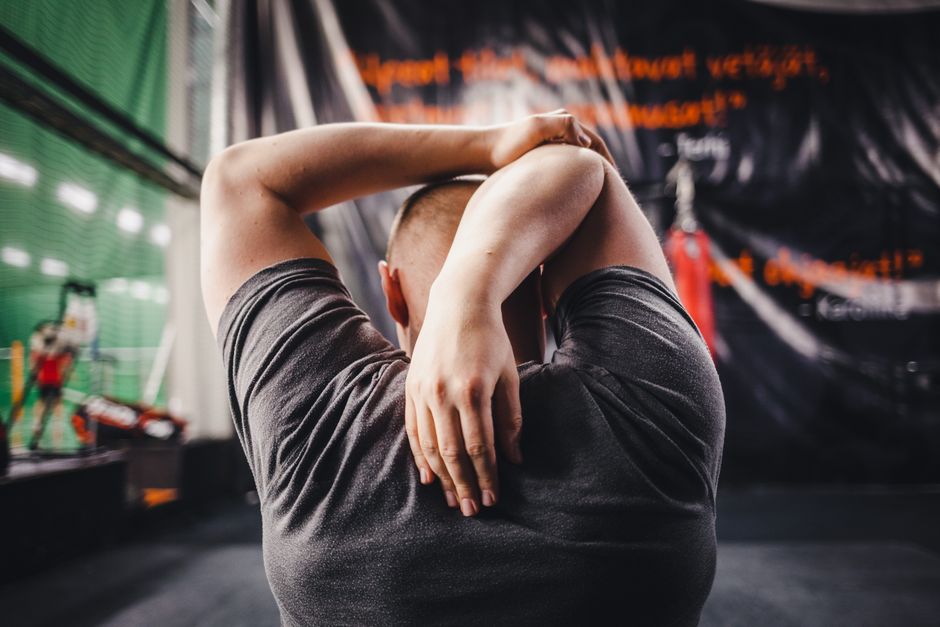
Upper back tightness is one of the most common complaints among people who sit for a living. Hours at a keyboard pull the shoulders forward and leave the muscles between the shoulder blades stiff and achy. The stretches below need no equipment beyond a wall, a chair, and a bit of floor space.
We ranked them by how much relief most people get per minute spent, starting with the ones that are easiest to do correctly.
How We Picked
- No equipment required. Every stretch works with a chair, a wall, or the floor. Nothing to buy.
- Targets the right area. Each one reaches the thoracic spine, rhomboids, or upper trapezius rather than the lower back.
- Hard to do wrong. We favoured positions where the body naturally finds the right alignment.
- Short. Most take 30 to 60 seconds per side, so the whole list fits into a short break.
- Widely recommended. These are standard movements taught by physiotherapists and in general mobility programmes, not novelty exercises.
1. Seated Cat-Cow
Sit on the front edge of a chair with your feet flat. Round your spine and drop your chin as you breathe out, then lift your chest and look slightly up as you breathe in. Move slowly and let the motion come from your mid-back rather than your neck. Six to eight rounds is plenty.
Best for: Loosening a stiff mid-back without leaving your desk.
2. Thread the Needle
Start on your hands and knees. Slide your right arm under your left, palm up, until your right shoulder and the side of your head rest on the floor. Keep your hips stacked over your knees rather than letting them drift. Hold for 30 seconds, then switch sides.
Best for: Rotation through the upper back and the muscles around the shoulder blade.
3. Child's Pose with Side Reach
Kneel, sit back toward your heels, and walk both hands forward until your chest lowers. Then walk both hands to the right and hold, feeling the stretch along your left side and the outer edge of your back. Switch directions after 30 seconds. Keep your forehead heavy and your breathing slow.
Best for: A broad stretch across the lats and upper back after sitting.
4. Doorway Chest Stretch
Stand in a doorway with your forearms on the frame, elbows at roughly shoulder height. Step one foot through until you feel a gentle opening across the chest and front of the shoulders. Keep your ribs down rather than arching your lower back. Hold 30 seconds.
Best for: Rounded shoulders, since tight chest muscles are often what keeps the upper back strained.
5. Wall Angels
Stand with your back, head, and hips against a wall and your feet a few inches out. Press the backs of your hands and elbows to the wall at shoulder height, then slide your arms up and back down while keeping that contact. Most people lose contact quickly, which is useful information. Eight to ten slow repetitions.
Best for: Working on posture and shoulder blade control at the same time as mobility.
6. Seated Thoracic Rotation
Sit tall in a chair with your feet planted and cross your arms over your chest. Turn your upper body to the right as far as is comfortable, pause for two breaths, and return. Keep your hips and knees facing forward so the rotation stays in your mid-back. Five rotations each way.
Best for: Desk workers who feel locked up when turning to look over a shoulder.
7. Upper Trapezius Stretch
Sit or stand with your shoulders relaxed. Tip your right ear toward your right shoulder and let the weight of your head do the work. For slightly more, rest your right hand lightly on the left side of your head without pulling hard. Hold 30 seconds per side and stop short of any sharp sensation.
Best for: The tight band between neck and shoulder that builds up over a long day.
8. Standing Forward Fold with Clasped Hands
Stand with your feet hip-width apart and clasp your hands behind your back. Hinge forward from the hips, letting your arms rise overhead as far as they comfortably go. Bend your knees as much as you need to. Hold 20 to 30 seconds, then roll up slowly.
Best for: Shoulders and upper back together, when you want one stretch rather than several.
9. Prone Y Raise
Lie face down with your arms extended overhead in a wide Y shape, thumbs up. Lift your arms and chest a few inches off the floor, hold for two seconds, and lower. This is closer to a strengthening move than a stretch, and that is the point: weak mid-back muscles are often part of the problem. Eight to twelve repetitions.
Best for: Building some endurance in the muscles that hold your shoulder blades back.
10. Foam Roller or Towel Extension
Place a foam roller, or a rolled towel if you do not have one, across your mid-back and lie back over it with your hands supporting your head. Let your upper back drape gently over the support for a few breaths, then shift the roller an inch and repeat. Keep the movement in your mid-back and avoid arching your lower back. Evidence on foam rolling is mixed, though many people report it feels good in the moment.
Best for: Extension through a mid-back that has spent all day rounded forward.
Common Mistakes
- Pushing into pain. A stretch should feel like mild tension. Sharp or shooting sensations mean back off.
- Holding your breath. Breathing normally helps the muscles release; bracing against the stretch works against you.
- Moving too fast. Bouncing in and out gives you less than one slow, held position.
- Stretching once a week. Two or three short sessions a day beat one long one, especially if sitting is the underlying cause.
- Ignoring the setup. Raising your screen to eye level and sitting back in your chair will do more over a month than any stretch on this list.
If tightness lasts for weeks, comes with numbness or tingling in your arms, or follows an injury, it is worth having someone look at it rather than stretching through it.
This article is for general information only and is not medical advice. Speak with a qualified healthcare professional before making significant changes to your diet, exercise, or health routine.